A quick guide to decreasing stress
Author: Keona Williams
This article is written with the intention of sharing observations and suggestions to the business professional. Additionally, there is documentation of suggested strategies to decrease stress at several levels. When beginning a career there is a lot no one has the chance to say to the career starter. The incentives will often go exalted and yet be minimal once career goals are beginning to develop. The career itself may be something different than what the individual envisioned initially, and there then is the necessity to weight decisions about continuing or redirecting. The work day can become stagnant for personal reasons and the interest that was the seed for beginning is lost. Prevention can often be found with the incentives actually coming to fruition. This article serves as a professional reminder of other ways to reduce stress daily.
What is stress? Stress is the body signaling overload of input sensory. It isn’t immediate as the body has natural responses to situations that are more detrimental than whatever is causing the stress. For instance, the body is equipped with hormones and physical ability to survive through life altering instances like a car accident. The body first tries to prevent the accident almost without us needing to do anything. Then the body seeks repair response once the situation occurs. A familiar response for most is “fight or flight” where the brain decides rather to fight through a situation or retreat. Physically healing from a life altering situation also likely has an increase of specific hormones to improve and increase activities like sleeping, the time when the body best repairs itself.
Stress isn’t the instant severity of a motor vehicle accident, yet the repeated psychological reinforcement of requirement overload being received does take its toll on the mind and eventually the body. Some signs of stress are headache, muscle tension, and lack of or increase of appetite. What we don’t say often enough is there is initially a change of attitude towards whatever is the source of stress. Someone experiencing stress is most likely to exhibit a change of emotion towards work required, and therefore work-related, activities before stress eating or experiencing a stress headache.
Reduction of stress doesn’t have to be complicated or begin pharmacologically. A few implements, or daily strategies, can greatly decrease the likelihood of stress. When considering organization consider the amount of reduction to the action required to implement. What’s required to organize is minimal compared to the amount of stress likely to be reduced. It requires less than an hour a day during a week to add the weekly items to a daily planner/scheduler, and less than 2 minutes to check the planner/scheduler to add or remove something. Cleaning can require less than a few hours yet save hours at a time when objects can be located immediately. These are the ideas we look at further now.
Organization
Organization is a major stress reducer. Organization implements focused attention and organization reduces confusion which is a source for stress. There are multiple contexts for organization and two are exactly what the doctor ordered for the purpose of this article. Most business professionals are probably familiar with the contexts and just haven’t implemented or utilized the tools or time. If it’s you there’s nothing to feel bad about but before the stress takes over let’s consider pros and cons, like those above and be realistic about what needs to be done. Remember, stress doesn’t show up immediately it also requires time.
Organizational tools are time management tools. Time management tools serve dual purposes. The ideal is to save time and reduce unproductive time. Decreasing unproductive time reduces stress. There’s nothing worse to the business professional than having a timeline be riddled with tasks that are not directly correlated to the objective. For some the occurrence of the instance for some can be small for others it may be extreme. Organizational tools also save time dually, often there is an ability to focus attention properly throughout the work week and properly organize whatever the requirements may be. One key organizational tool is the daily planner.

A daily planner is a necessity to the business professional. The phrase business professional doesn’t refer to just the CEO of a corporation. It can be anyone whose work is of a professional capacity. It is anyone who has the necessity to foresee what is required of time before the time approaches, this can include students also. A daily scheduler maps out an hour, day, week, month, or year. The organizational tool can be either electronic or book style. Sometimes a hybrid approach can work best depending on the personality type of the business professional. As far as stress reduction it is minimal in requirement and optimal for result. The daily planner/scheduler can be utilized to document either meetings, specific tasks, or any other activity that requires the business professional to be at or step away from the core constructs of the job. For instance, a corporate executive accountant may have meetings and phone calls that need to be scheduled outside of a core construct of balancing/reviewing the ledger of the corporation. The idea is to streamline multiple career functions to reduce stress while completing the functions of the career.
Another context of organization is cleanliness. A clean work and home are two vitally important places for cleanliness. Organization of work required materials allows for access to materials without the necessity of searching. Have you ever lost or misplaced your vehicle keys? You spend all day looking only to find them somewhere that’s frustrating. Organization prevents the previously mentioned from occurring. Have you ever gotten an impromptu phone call and can’t find a pen to write an important piece of information down? Organization prevents that also. Organizational cleanliness puts everything in its place for immediate location and utilization. Not only does it save time it reduces the amount of unproductiveness one is likely to complete when unexpected business occurs.
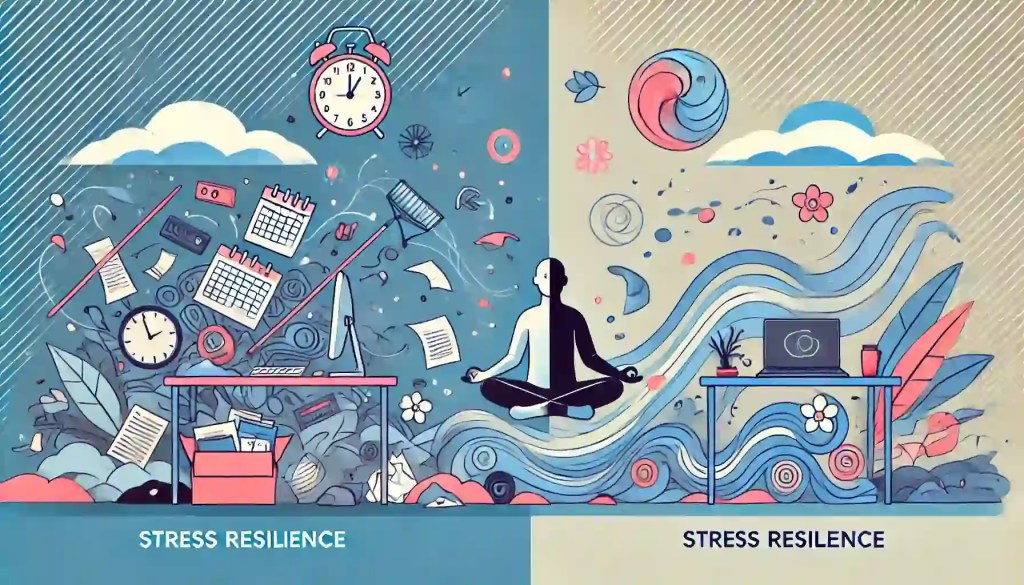
A clean home serves dual purposes. Organized clothes can save time during the morning routine. Everything required to leave the home being properly locatable serves a similar purpose. What isn’t mentioned often is that visual signals can be responsible for what signals the brain receives. Consistently working, and/or living, can cause feelings of stress and stress-related symptoms. Like highlighted via the image at the top of the page, clutter can have adverse effects. Clutter is most likely to send slight signals of distress after an extended amount of time. In addition to signals of distress, sickness is also plausible when things are a mess. When things are disinfected and sanitized properly the likelihood of sickness is decreased. A healthy person is least likely to have adverse effects become problematic or repetitive during their career.
Self-care
Another major source for reducing stress is self-care. Initially introduced to the concept during undergraduate studies, self-care reinforces stress reduction. Self-care is the concept of allowing time specifically for the self. It is reinforcement of love of self. Psychology doesn’t really have medical jargon for love of self; we can instead say things like it reinforces self-esteem, self-efficacy, confidence, and supports the brain, mind, and body function properly. Initially at the time of introduction to self-care, I thought of spa days and mall shopping for strategies of implementation. While the pampering suggestions don’t fall short, things like eating healthy; exercising; budgeting; and proper amounts of sleep exhibit benefits similar yet extended to pampering of one’s self.
Healthy eating is a simple way of implementing self-care. We feel better when we exercise healthy nutritional habits, therefore being able to perform better at career/work. Relationships can even improve due to increase of self-motivating factors being positively effected by nutritional choices. When we feel better we’re better people. When we’re better people, we’re better people wholly. While no food, that can be named here, specifically reduces stress fruits and vegetables have great effects on the body’s organs. With blue berries supporting healthy blood flow, eating a bowl when a headache ensues may not be a bad idea. Tomatoes are excellent seeding fruits, so have a few slices when you’re feeling great and are eating a meal a tomato compliments. Add broccoli to the list and you have increased immune support and heart health support. Everyone’s body isn’t biologically the same so be sure to consult with your physician before making any major changes to your diet.

Sleeping is another daily activity that either affects or effects stress. Affect is the negative of effect, and effects can vary but contribute to the result of an outcome. For the longest it was thought that everyone needed 8 hours of sleep. Recent studies suggest infants sleep most, children need approximately 10 – 12, and adults are recommended 8 – 6 hours daily. The data is the same, to an extent, the question is are we all getting our required amount of sleep daily. Working on projects, having a social life, or just laying in bed watching television or reading can all affect the amount of sleep one is actually able to get each night. Sleep is vital to the body mainly because it is when the body repairs itself, likely connected to the circadian rhythm of the brain. There are also several phases of sleep that constitute proper sleep, a few misses in either phase and there could be a cranky business professional. Ideally, sleep supports a healthy person and healthy people are free of or experience reduced stress.
The idea is to implement and complete a few activities daily that are both organization and self-care oriented. When anyone, not just the business professional, is looking to reduce stress organization and environmental cleanliness can be important factors. While clutter free is organized, it is important to remember that cleanliness can also mean sanitation and disinfecting. Dust, allergens, and germs are lurking where least and most expected sometime. Furthermore, eating and sleeping healthily can increase improved health therefore reducing stress. Reduced stress allows for productivity and healthy living for the business professional and others.
photo credit: diary/daily planner, quapri.in; cleanliness, enotalone.com; nutritional plate, fitty.club;

